


By ACJ UNIBEN
The 2024/2025 Students’ Union elections at the University of Benin (UNIBEN) have come under fire following widespread complaints of technical failures that left many students unable to access the voting portal during critical hours on Thursday, July 24 2025.
According to reports from across multiple faculties, the official election website, https://votingportal.uniben.edu/auto/index.html, was largely inaccessible on Thursday, between 11:00 a.m. and 12:00 p.m., which was the official voting period. Although the voting timeframe was later extended to 12:50 p.m. after the ICT Unit became aware of the issue, students attempting to log in during the entire period were either locked out entirely or encountered persistent errors that prevented them from casting their votes.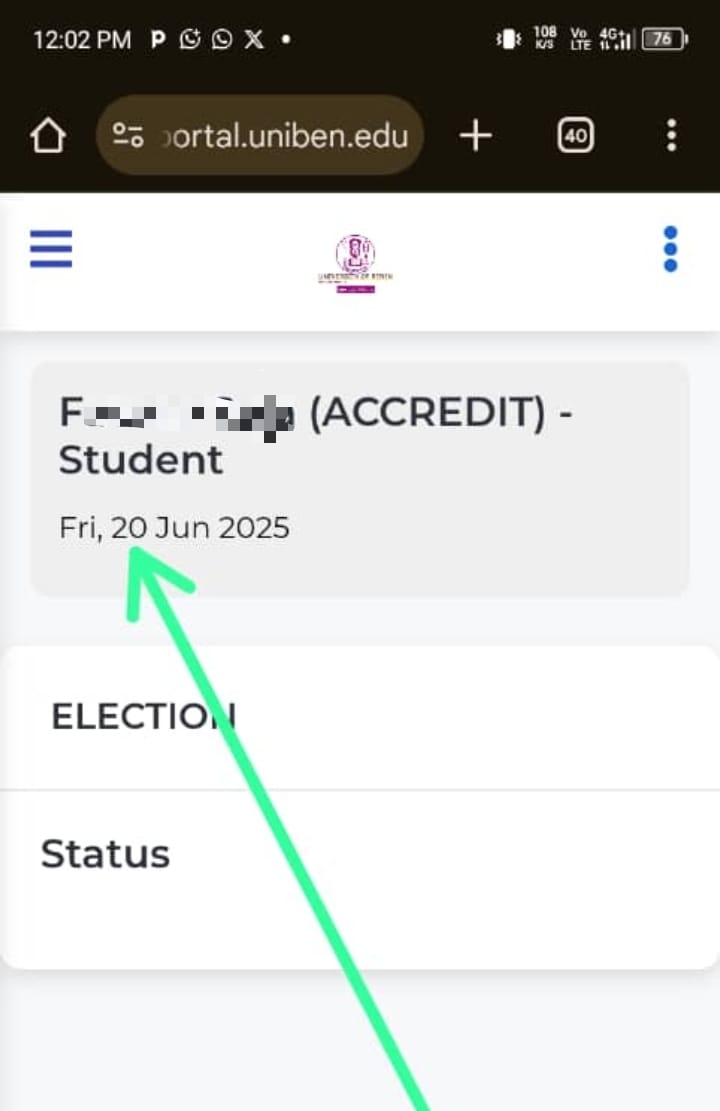
Adding to the confusion, students observed that the date and time displayed at some point on the voting portal were inaccurate. While the election was held on Thursday, July 24, the website curiously showed the date as Friday, June 20, 2025, and the system clock appeared to be one hour behind the actual time. Many students expressed concern that such inconsistencies further undermined the credibility of the process.
“I tried logging in for nearly an hour, and the site just wouldn’t load. By the time it finally worked, it was already too late. I couldn’t even see the names and pictures of the candidates. All I saw was ‘Welcome Admin’, so I couldn’t vote,” a 400-level student from the Faculty of Life Sciences recounted.
This sentiment was echoed across various departments and faculties, including Law, Arts, Social Sciences, Pharmacy, Engineering, and Education. Many students expressed frustration that they were effectively disenfranchised, unable to participate in a process fundamental to student representation.
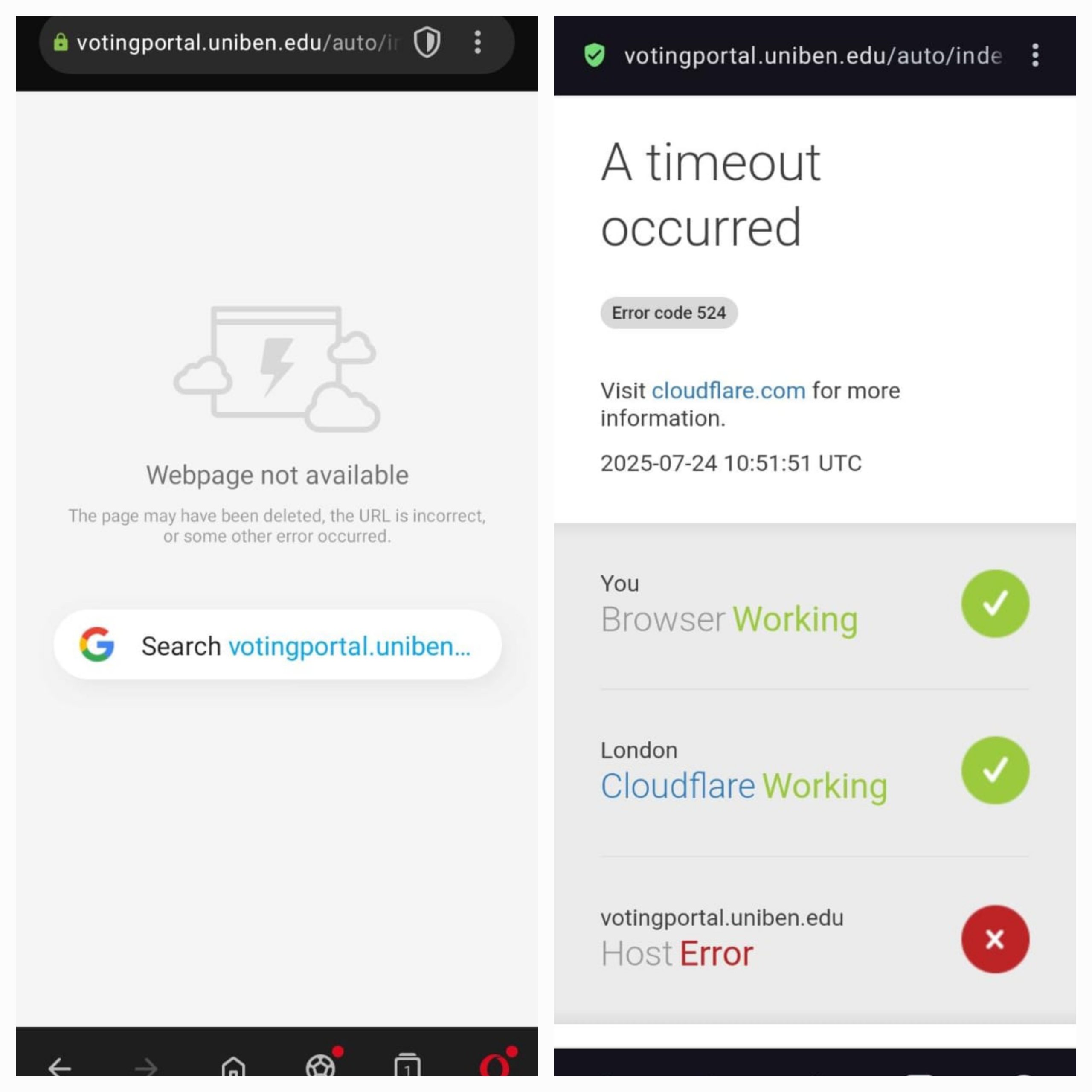
“I did not vote because I couldn’t log into the site. The website was hanging,” said Nicholas, a 200-level student.
“The election was a tough one. I had difficulties voting, but after several tries, I finally voted,” shared Moses, a 300-level student. “I voted for Blessing for Vice President. If she wins, I hope she fulfils all the promises she made in her manifesto.”
For some students who were able to vote, the process worked only briefly. Emeka, a 300-level student, revealed: “I logged in as quickly as I could and was able to vote. I voted for Michael for Director of Welfare. If he eventually wins, I hope he fulfils his promises.”
However, the voting irregularities were not limited to technical glitches. Reports also surfaced that some students shared their login credentials with others, allowing them to vote multiple times or on behalf of others.
Even more troubling were reports that students could edit the names and positions of candidates directly on the website interface before submitting their votes. Several screenshots circulating online showed that the editable text fields meant that candidate details could be tampered with on the client side, raising serious questions about the platform’s integrity and the security of vote data.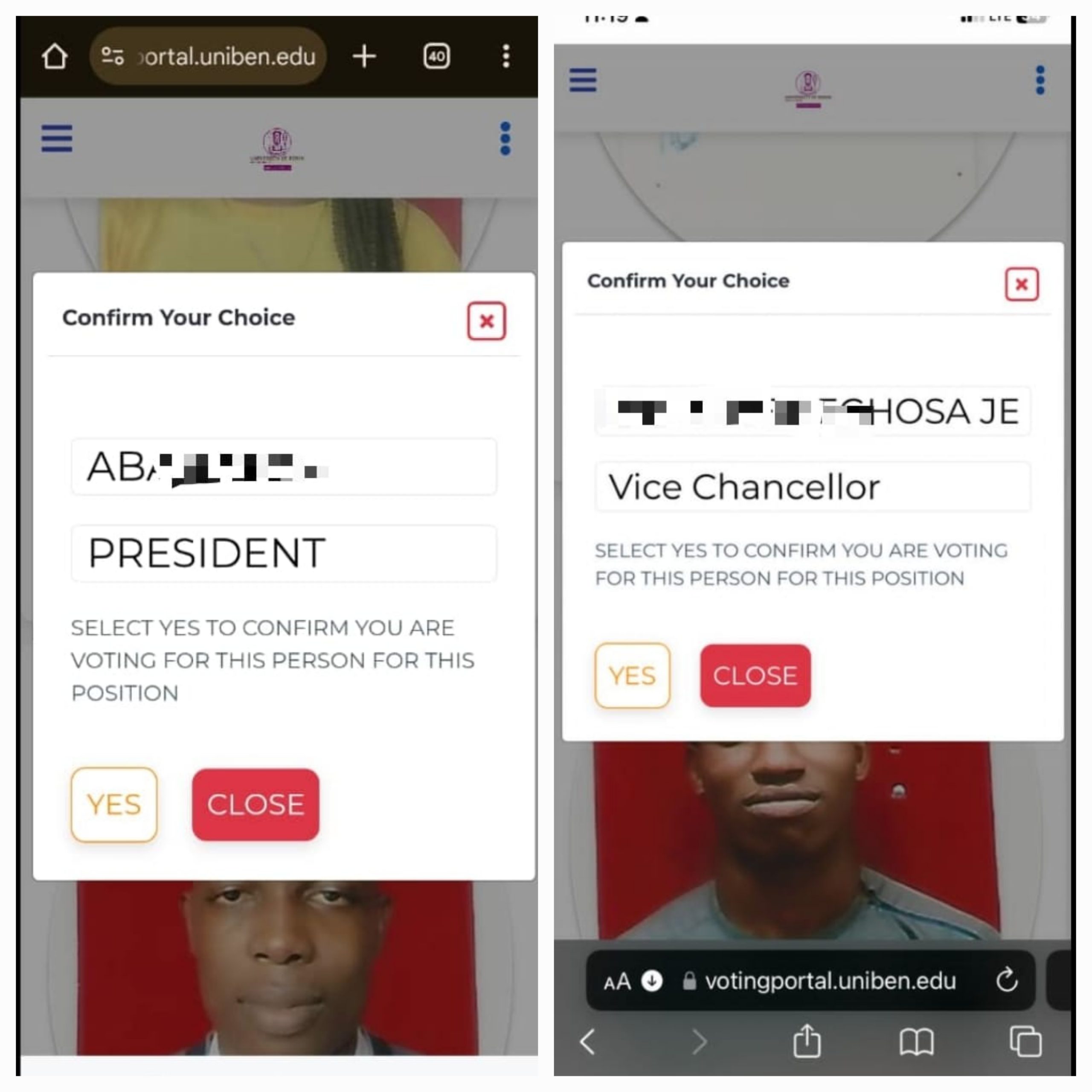
“People gave out their details to their friends and leaders just to make sure their candidate got more votes. That’s how disorganised it became,” a student from the Faculty of Engineering disclosed anonymously.
The election witnessed an unusually low turnout, attributed to both technical challenges and student apathy. According to findings by the Association of Campus Journalists (ACJ UNIBEN), approximately 25% of students lacked awareness about the election or familiarity with the SU candidates, a factor that also affected participation.
“I wasn’t familiar with any of the candidates, so I didn’t vote,” admitted Naomi, a 400-level student.
These issues have stirred fresh debates about the effectiveness of digital voting at the university. This year marked the second time UNIBEN has adopted an online platform for Students’ Union elections, a move originally heralded as progressive. However, continued glitches and poor voter experience have cast doubt on the system’s reliability.
In the aftermath of the election, a growing number of students are now demanding an end to online voting altogether, arguing that the university’s ICT Unit has failed to deliver a stable and credible digital platform.
“We have given online voting two chances now, and both have been plagued by serious technical issues. It’s time we return to the physical method if the ICT Unit cannot manage a stable and secure platform,” said a student from the Faculty of Management Sciences.
Critics argue that while digital elections are convenient in theory, they have resulted in confusion, distrust, and exclusion in practice. Many are urging the university administration to reassess its reliance on the ICT Unit for future student-centred exercises like elections.
Students have also called for greater publicity of candidates, improved stability of the UNIBEN platform, and more voter education, especially among first- and second-year students who may not fully understand the importance of Students’ Union leadership.
As of the time of filing this report, neither the ICT Unit nor the Dean of Students’ Affairs has issued an official statement addressing the technical breakdown or the widespread complaints. Meanwhile, conversations continue to escalate across campus group chats and communities, with the majority calling for transparency, accountability, and a return to physical voting systems in future elections.

Support ACJ UNIBEN's goal of always bringing truth to light.
Excellent campus journalism requires financial support. Yet, it is this very journalism that contributes to an informed campus community, transparency in educational institutions, and an engaged student body. To continue offering free access to top-notch campus journalism, we invite you to consider making a modest contribution to this worthwhile endeavor. Your support for ACJ UNIBEN's campus journalism ensures its relevance and availability to all students, free of charge, fostering an informed and active campus community.
DONATE